

Making a great cookie on a commercial scale involves much more than simply scaling up a kitchen recipe. The equipment used to mix the dough, form the cookies, and bake them can have a major impact on texture, appearance, consistency, production efficiency, and even the types of recipes that can be successfully manufactured.
Cookie manufacturing equipment ranges from relatively flexible batch systems to highly automated production lines capable of producing thousands of pounds per hour. Neither approach is inherently better. The right equipment depends on the type of cookie, the ingredients being used, the required volume, and the amount of flexibility a manufacturer needs.
Understanding these differences is especially important for emerging and mid-sized brands. A highly automated line may deliver tremendous efficiency at very large volumes, but it can also require extremely large production runs. More flexible equipment can accommodate a wider variety of products while keeping production minimums at more reasonable levels.
It Starts With the Dough: Commercial Cookie Mixing Equipment
Cookie manufacturing begins with mixing, and the type of mixer used can significantly affect the finished product. Unlike many bread doughs, cookie dough generally requires controlled incorporation of fats, sugars, flour, inclusions, and other ingredients without excessive gluten development.
Several types of commercial mixers are commonly used.
Single-Arm Dough Mixers
Single-arm mixers use a heavy-duty mixing arm to work ingredients through the bowl. They can be particularly useful for dense cookie doughs where considerable torque is required.
One of their biggest advantages is versatility. They can handle substantial dough loads and relatively stiff formulations while providing controlled mixing.
The tradeoff is that they may not provide the same speed or degree of mixing action as more aggressive mixer designs. Depending on the formula, cycle times can be longer.
For manufacturers producing multiple cookie styles rather than one product continuously, however, this flexibility can be a significant advantage.
Double-Arm Dough Mixers
Double-arm mixers use two mixing arms working together to fold, knead, and blend the dough. These mixers are particularly effective with dense or heavy doughs and can provide very thorough ingredient distribution.
Advantages include excellent handling of stiff doughs, good incorporation of inclusions, and relatively gentle dough development. They can work especially well with cookie doughs containing chocolate chips, nuts, candies, dried fruit, or other particulates.
Their primary disadvantage is that they are generally batch-oriented rather than continuous. For extremely high-volume production, continuous mixing systems can offer greater throughput.
For flexible manufacturing, however, batch mixing can actually be beneficial because it makes changing recipes and producing different products considerably easier.
Planetary Mixers
Planetary mixers are among the most familiar commercial mixing systems. The mixing attachment rotates while also traveling around the bowl, creating the planetary motion that gives the mixer its name.
These mixers are extremely versatile and can use paddles, whips, dough hooks, and other attachments.
For cookie manufacturing, planetary mixers work well for many softer doughs, creams, fillings, and products requiring creaming of fats and sugars.
Their disadvantage is that extremely stiff cookie doughs can put considerable stress on the mixer, and large-scale planetary mixers may not always be the best choice for very dense formulations.
Horizontal and High-Capacity Mixers
Large cookie plants frequently use horizontal mixers designed for very large batches. Horizontal shafts equipped with paddles or other mixing elements can rapidly distribute ingredients throughout the dough.
These systems offer high throughput, consistency, and excellent integration with automated production lines.
The disadvantage is scale. Large mixers require large batches, which can translate directly into larger production minimums. Cleaning, allergen changeovers, and switching between formulas can also become significant considerations.
For a factory making the same cookie continuously, this can be an excellent solution. For a co-manufacturer making many different products for different customers, flexibility may be more valuable than maximum throughput.
Forming the Cookie
Once the dough is mixed, it must be portioned and formed. This is one of the biggest differences among commercial cookie production systems.
The forming method determines not only production speed but also what kinds of doughs, shapes, inclusions, and textures can be produced.
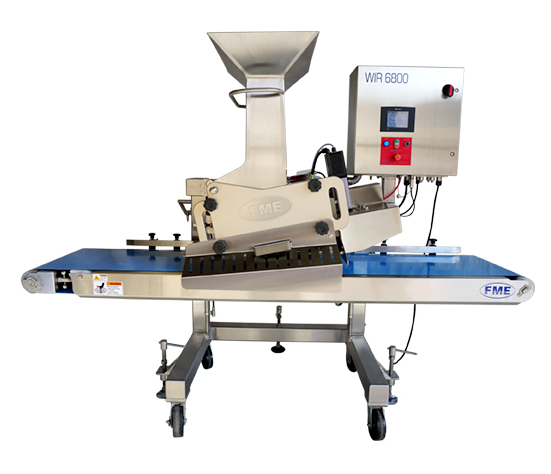
Wirecut Cookie Machines
Wirecut systems are one of the most versatile technologies in commercial cookie manufacturing.
Cookie dough is fed through a die to create the desired cross-section. A wire passes underneath the die and cuts individual portions of dough, which are deposited onto a pan, belt, or baking surface.
Wirecut equipment works particularly well for traditional American-style cookies such as chocolate chip, oatmeal, peanut butter, and many other drop-cookie formulations.
Wirecut systems can accommodate many doughs containing particulates such as chocolate chips, nuts, and certain candies, although inclusion size must be compatible with the die and cutting system.
The major advantage is flexibility. Dies can be changed, portion sizes can be adjusted, and many different formulations can be produced on the same machine.
The limitations generally involve very soft, sticky, or extremely large-particulate doughs, which may require formulation or processing adjustments.
Rotary Molders
Rotary molding is commonly used for cookies requiring a highly defined shape or surface pattern.
Dough is pressed into engraved cavities on a rotating roll. The molded pieces are then extracted and transferred to the baking surface.
Rotary molders are excellent for producing products such as shortbread-style cookies, sandwich-cookie shells, embossed cookies, and many traditional biscuits.
Their biggest advantage is shape definition. Detailed logos, patterns, lettering, and decorative surfaces can be produced consistently at high speeds.
The disadvantage is flexibility. Each cookie shape typically requires dedicated tooling, and the dough must have the proper characteristics to release cleanly from the mold. Large inclusions such as chocolate chunks or nuts can also be problematic.
Depositors
Depositing equipment portions softer dough or batter directly onto pans or oven belts.
Depositors can be very effective for soft cookies, filled products, and formulations that cannot easily be wirecut or rotary molded. Depending on the equipment, depositors can also create different shapes and portion weights.
The advantage is the ability to handle softer formulations with excellent portion control.
The disadvantage is that very stiff doughs or formulas containing large inclusions may not flow properly through the depositing system.
Extrusion and Bar-Style Forming
Some cookie products can also be extruded through dies and subsequently cut into individual pieces.
Extrusion provides excellent portion consistency and can create unique shapes. It can also be useful for dense dough systems and products that fall somewhere between traditional cookies, nutrition products, and snack bars.
However, the dough must have the proper rheology to move through the extrusion system without damaging its structure or causing excessive pressure.
Sheeting and Cutting
Sheeted cookies begin with dough that is rolled into a continuous sheet. The sheet is progressively reduced to the desired thickness and then cut into shapes.
This approach is commonly used for crackers, biscuits, graham-style products, and certain crisp cookies.
Sheeting offers excellent thickness control and can operate at very high speeds.
Its disadvantage is that it requires dough capable of being sheeted without sticking, tearing, or excessively shrinking. It can also require a substantial amount of floor space and additional equipment.
Baking Equipment: Where Dough Becomes a Cookie
Forming determines what a cookie looks like going into the oven. Baking determines much of what the consumer ultimately experiences.
Heat transfer affects spread, moisture loss, browning, texture, flavor development, and shelf stability.
Commercial bakeries primarily use several different oven configurations.
Rotating Rack Ovens
Rotating rack ovens bake cookies on pans loaded onto rolling racks. During baking, the rack rotates within the oven while heated air circulates around the product.
One of the greatest advantages of a rack oven is flexibility.
Different products can be loaded into the same oven without requiring an enormous continuous production run. Temperature, time, airflow, and other parameters can be adjusted according to the product.
Rack ovens are therefore particularly well suited to bakeries and co-manufacturers producing multiple SKUs and changing products frequently.
The disadvantage is throughput. A rack oven is a batch system, so it cannot match the enormous continuous output of a large tunnel oven.
Tunnel Ovens
Tunnel ovens are the workhorses of very high-volume cookie production.
Cookies travel continuously through a long oven on a conveyor. Different oven zones can be independently controlled to manage initial spread, structure development, moisture removal, and final browning.
Tunnel ovens can provide exceptional consistency and tremendous throughput.
Their disadvantage is the investment and scale required to operate them efficiently. Starting, stopping, warming up, cooling down, and changing products can create substantial inefficiencies.
For a company producing millions of essentially identical cookies, that tradeoff makes sense. For a company producing many different products and smaller individual runs, it may not.
Conveyor and Continuous Ovens
Continuous ovens are available in many configurations between relatively compact conveyor systems and massive industrial tunnel ovens.
They can offer better throughput than batch ovens while requiring less infrastructure than the largest tunnel systems.
However, they still tend to favor longer production runs because changeovers and oven stabilization take time.
Automation Versus Flexibility
There is an important economic distinction between equipment that can make a cookie and equipment that can make that cookie economically at a particular volume.
A fully automated cookie line might include automated ingredient handling, a large horizontal mixer, automated dough transfer, a high-speed rotary molder or wirecut system, a continuous tunnel oven, cooling conveyors, metal detection, and automated packaging.
At sufficient volume, this can produce cookies at extraordinary speeds and very low unit labor costs.
But there is another side to that efficiency.
The larger and faster the line becomes, the more expensive short production runs can become. Startup waste, dough remaining in equipment, oven stabilization, cleaning, allergen changeovers, packaging changeovers, and production downtime all have to be distributed across the production run.
That is one reason large automated cookie plants frequently require very high minimum order quantities.
For an emerging brand, specialty retailer, private-label program, or company launching a new cookie, those volumes may simply be too large.
World Wide Gourmet Foods Takes a Flexible Approach to Cookie Manufacturing
At World Wide Gourmet Foods, we have intentionally developed our cookie manufacturing capabilities around flexibility rather than building a factory designed to produce only one type of cookie at extremely high speed.
Our cookie production capabilities include both single-arm and double-arm dough mixers, giving us the ability to work with a variety of dough densities, ingredient systems, and inclusion levels.
For cookie forming, we use an FME CCM Wirecut dough depositor, providing the flexibility to produce multiple cookie styles, sizes, and formulations while maintaining consistent portioning.
Our cookies are baked using rotating rack ovens, rather than requiring every product to run through a massive continuous tunnel oven.
That combination creates a manufacturing system that is particularly well suited to co-manufacturing.
Instead of designing the entire production line around one cookie and one enormous production volume, we can adjust the process to accommodate different recipes, dough characteristics, inclusions, cookie sizes, bake profiles, and finished-product requirements.
Keeping Cookie Manufacturing Minimums Reasonable
Flexibility also has an important financial benefit for our customers.
Fully automated cookie lines are extraordinarily efficient when they are running huge volumes, but that efficiency often comes with very high minimum production requirements. For a brand launching a new product, expanding into a new retailer, testing a new flavor, or simply operating at a moderate scale, those minimums can become a significant obstacle.
The flexible manufacturing approach at World Wide Gourmet Foods allows us to keep production minimums at more reasonable levels while still using commercial manufacturing equipment and controlled production processes.
That can provide growing brands with a bridge between small-scale bakery production and the enormous volumes required by the largest automated cookie factories.
It also means customers can work with a manufacturer capable of supporting a product through multiple stages of its development.
More Than Cookie Manufacturing
Equipment is only part of successfully commercializing a cookie.
A formula developed in a kitchen may behave very differently when mixed in a commercial dough mixer, portioned through a wirecut system, and baked hundreds or thousands of cookies at a time. Ingredient temperature, mixing sequence, dough hydration, fat characteristics, sugar particle size, flour absorption, inclusion size, dough resting time, portion weight, spread, oven temperature, airflow, and bake time can all affect the finished product.
That is why commercial cookie development requires an understanding of both food science and manufacturing equipment.
World Wide Gourmet Foods is an expert in cookie manufacturing, recipe development, and commercialization. We work with brands to take cookie concepts from the development stage through commercial trials and into repeatable production.
Our flexible combination of dough mixing, wirecut forming, and rotating rack oven baking allows us to manufacture a wide range of cookie products without forcing every customer into the enormous minimums associated with fully automated cookie lines.
For brands looking to develop a new cookie, improve an existing formula, or move a successful kitchen concept into commercial production, World Wide Gourmet Foods provides the equipment, manufacturing experience, and product-development expertise needed to turn a recipe into a commercially viable packaged product.
Leave a Reply