

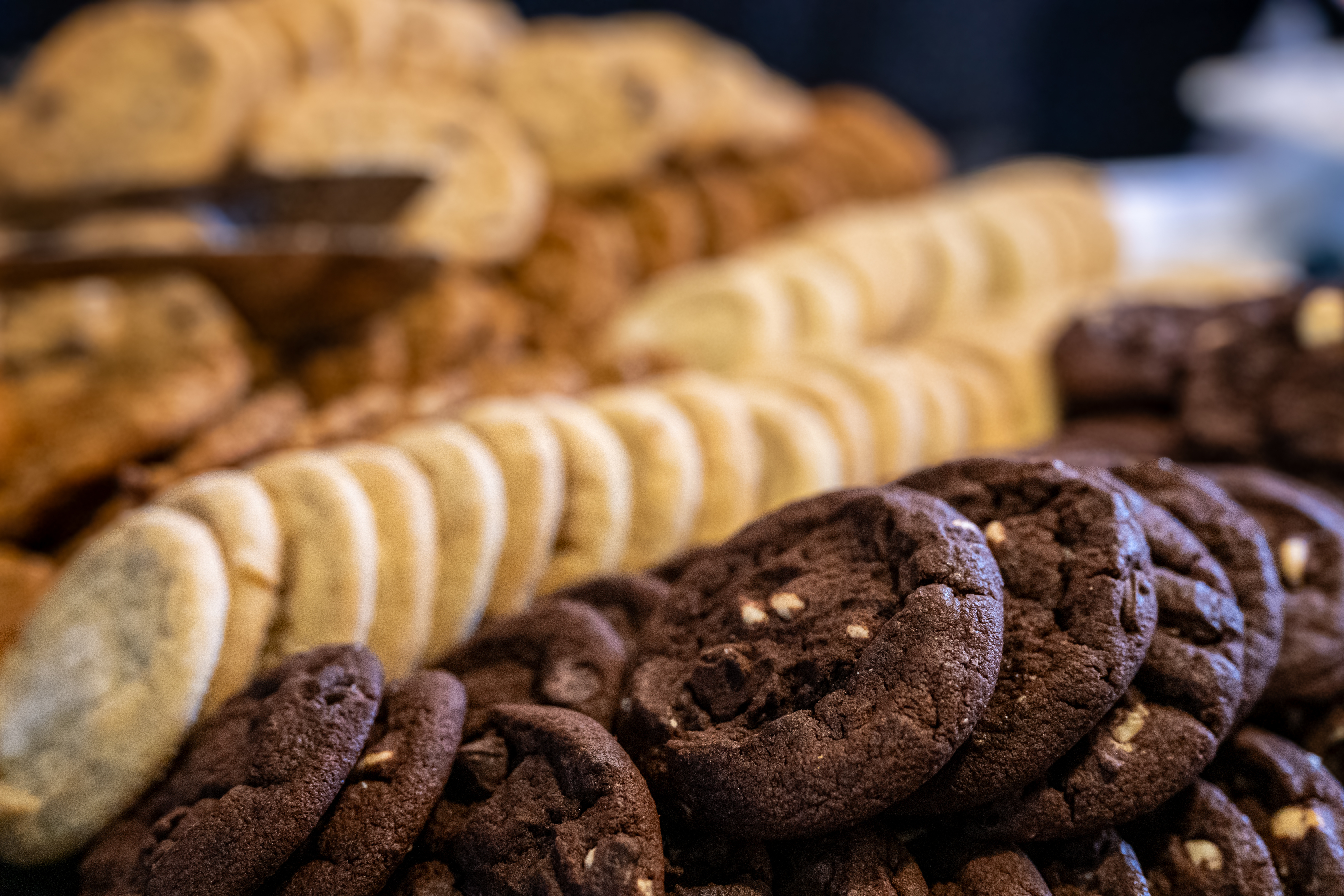
Texture is one of the defining characteristics of a great cookie. Two cookies can use similar ingredients and even have similar flavors, yet deliver completely different eating experiences. One might be soft, moist, and chewy; another thin and crisp; and another somewhere in between, with a crisp exterior and a tender center.
Achieving those differences consistently at commercial scale requires more than changing a baking time. Cookie texture is the result of an interconnected system involving ingredients, moisture, fat, sugar, dough development, forming, baking, cooling, packaging, and shelf life.
At World Wide Gourmet Foods, we approach cookie development with the understanding that texture and flavor have to be designed together—and that the cookie needs to deliver the intended experience not only when it leaves the oven, but throughout its commercial shelf life.
Ingredients Are the Foundation of Cookie Texture
A cookie’s texture begins with its formula. Flour, sugar, fat, eggs, water, proteins, fibers, starches, leavening agents, and inclusions all influence how dough behaves during forming and baking.
Flour and Protein
Wheat flour provides much of a cookie’s structure. When flour proteins hydrate and are mechanically worked, they can develop gluten. The amount of gluten development has a major effect on texture.
Too much gluten development can make a cookie tough or bread-like. Less gluten development generally produces a shorter, more tender texture.
Flour selection therefore matters. Protein level, starch characteristics, particle size, and water absorption can all change dough behavior.
Mixing is equally important. The same formula can produce noticeably different cookies depending on ingredient addition order, mixing time, dough temperature, and how aggressively the dough is worked.
Sugar Does Much More Than Add Sweetness
Sugar has a major structural role in cookies.
Different sugars influence moisture retention, spread, browning, crispness, and chewiness differently. Granulated sugar often contributes to spread and crispness, while ingredients such as brown sugar, syrups, and certain other sweeteners can increase moisture retention and produce a softer or chewier texture.
Sugar also participates in browning reactions during baking, which contribute both color and flavor.
Changing the type or amount of sugar can therefore change a cookie’s sweetness, flavor, diameter, thickness, surface appearance, moisture content, and texture simultaneously.
This becomes particularly important when developing reduced-sugar or no-added-sugar cookies. Replacing sugar is rarely as simple as substituting another sweetener at the same sweetness level because the replacement also has to compensate for sugar’s physical functions in the dough.
Fat Controls Tenderness and Spread
Fat contributes richness and flavor, but it is also one of the primary tools for controlling cookie texture.
Fat can coat flour particles and limit gluten development, helping create a tender or “short” texture. The amount of fat, its melting profile, and whether it is liquid or solid at different temperatures can also affect how quickly a cookie spreads in the oven.
Butter, shortenings, oils, nut butters, and other fats can consequently produce very different results even when their total fat contents appear similar.
The interaction among fat, sugar, flour, and water is especially important. Changing one frequently requires adjusting the others.
Designing a Soft-Baked Cookie
A good soft-baked cookie needs to retain sufficient moisture while still developing enough structure to survive packaging, shipping, and handling.
Formulas for soft cookies frequently use ingredients that help bind or retain moisture. Brown sugars, syrups, certain fibers, starch systems, fats, and other humectant ingredients can all play a role depending on the desired ingredient statement and nutritional profile.
The baking process is equally important.
A soft cookie generally needs to be baked sufficiently to establish its structure and achieve food-safety and quality requirements without removing so much moisture that the cookie becomes dry.
Thickness can help. A thicker deposited or formed piece provides more opportunity to establish a baked exterior while retaining a softer center.
But commercial soft-baked cookies present another challenge: the texture needs to remain soft throughout shelf life.
That requires controlling water activity, moisture migration, packaging, and ingredient interactions rather than simply underbaking the cookie.
Designing a Thin, Crispy Cookie
A crisp cookie requires a different strategy.
Typically, the goal is greater spread, a thinner finished profile, and lower residual moisture. Formula and process are adjusted so that the dough spreads appropriately and sufficient moisture is driven from the cookie during baking.
Sugar selection, fat system, flour characteristics, leavening, dough temperature, piece weight, oven temperature, bake time, and airflow can all affect the final result.
A thin cookie is particularly sensitive to small process variations. A slight change in deposited weight or dough temperature can change diameter and thickness, which then changes the rate at which moisture leaves the cookie.
Packaging becomes critical because a perfectly crisp cookie coming out of the oven can lose that texture if it absorbs moisture from the environment.
For a commercially packaged crisp cookie, achieving low enough moisture is only part of the solution. The packaging material also needs an appropriate moisture barrier so that the cookie remains crisp during distribution and storage.
The Traditional Cookie: Between Soft and Crispy
Many consumers prefer a cookie that falls somewhere between the two extremes.
This type of cookie may have a lightly crisp exterior with a more tender interior, or simply a firm bite without being either brittle or soft-baked.
Creating this texture requires balancing spread, moisture loss, fat, sugar crystallization, and structure.
Baking conditions can be manipulated to establish the desired exterior while maintaining enough internal moisture to prevent the cookie from becoming overly hard.
This middle category can actually require very precise process control because relatively small changes can push the cookie toward either extreme.
Forming and Extrusion Affect Texture
The way dough is formed has a direct impact on the finished cookie.
Commercial forming equipment controls more than shape. It determines piece weight, thickness, density, surface area, and sometimes how much mechanical work is applied to the dough.
Extrusion pressure can compact dough and alter its structure. Dough temperature can affect how cleanly it forms and how much the cookie subsequently spreads. A warm dough containing a temperature-sensitive fat system may behave very differently from the same formula processed several degrees cooler.
Piece dimensions are particularly important.
A thicker piece retains moisture differently from a thinner piece. Increasing surface-area-to-mass ratio generally allows moisture to escape more readily during baking, while a thicker cookie can retain a softer center.
This means the cookie formulation and forming process should ideally be developed together.
A formula that works beautifully as a hand-scooped kitchen cookie may not behave the same way when commercially mixed and mechanically formed. Successful commercialization requires adapting the recipe to the manufacturing process while preserving the intended eating experience.
Baking Is a Texture-Control Process
Commercial baking is not simply a matter of determining an oven temperature and bake time.
Heat transfer, airflow, humidity, oven loading, pan characteristics, cookie spacing, piece size, and the rate at which moisture leaves the product can all influence texture.
Higher temperatures and shorter bake times can produce different moisture gradients and surface characteristics than lower temperatures and longer baking cycles.
The objective is to create a repeatable baking profile that delivers the target color, flavor, dimensions, moisture, water activity, and texture.
Consistency becomes particularly important at commercial scale. A cookie that varies substantially from the beginning to the end of an oven load can create problems not only with appearance but also with shelf life and packaging performance.
Cookie Texture Continues to Change After Baking
A cookie isn’t necessarily finished changing when it leaves the oven.
Moisture continues to redistribute within the cookie during cooling and storage. Moisture can also migrate between different components of a cookie.
For example, chocolate, caramel, fruit pieces, marshmallow-type components, fillings, nuts, and other inclusions can create localized differences in moisture and fat.
Over time, a soft cookie may become firmer as moisture is lost or redistributed. A crisp cookie can soften if it absorbs moisture. Fats can change crystalline structure. Starches can undergo changes during storage. Flavors can oxidize or migrate.
This is why evaluating a new cookie immediately after baking isn’t enough.
Commercial product development should consider how the cookie performs after several days, several weeks, and ultimately throughout its intended shelf life.
Packaging is part of that equation. Film barrier properties, seal integrity, package headspace, oxygen exposure, and environmental humidity can all influence the eating quality a consumer experiences months after production.
The real target isn’t necessarily “the perfect cookie on Day 1.”
It is a cookie designed so that its texture remains within an acceptable sensory range from the beginning through the end of its intended shelf life.
Better-for-You Ingredients Change the Equation
Developing better-for-you cookies can make texture development substantially more complicated.
Replacing traditional ingredients often changes the fundamental chemistry and physics of the dough.
Reduced sugar, alternative sweeteners, whole grains, gluten-free flours, nut flours, resistant starches, soluble and insoluble fibers, protein concentrates, protein isolates, and functional ingredients can all affect water absorption, dough viscosity, spread, browning, aeration, and moisture retention.
A formula therefore cannot usually be converted into a better-for-you cookie by simply removing one ingredient and replacing it gram-for-gram with another.
Added Protein Can Make Cookies Harder
Protein is a good example.
Adding whey, milk, pea, soy, or other protein ingredients can increase water demand and change the structure of the dough. Depending on the protein and concentration, the finished cookie can become harder, drier, denser, less tender, or less prone to spreading.
High-protein cookies therefore often require adjustments elsewhere in the formula.
Those adjustments might involve changing the fat system, increasing or redistributing available moisture, modifying sweeteners or humectants, changing flour levels, introducing functional starches, adjusting leavening, or changing the forming and baking process.
The solution depends on the desired nutritional target and eating experience.
A 5-gram-protein cookie and a 20-gram-protein cookie are fundamentally different formulation challenges.
Fiber Can Dramatically Change Water Management
Added fiber creates similar challenges.
Many fibers have significant water-binding capacity. They can make dough thicker, reduce spread, increase density, or create dry and gritty textures if the formula isn’t properly balanced.
Other fibers may contribute gumminess or unexpected moisture retention.
Successful high-fiber cookie development therefore requires understanding the particular fiber rather than simply calculating how many grams are required to make a nutritional claim.
Water may need to increase. Fat may need to change. Mixing order can become important. The dough may need additional hydration time. Forming parameters may need adjustment. Oven conditions may also need to change.
The final cookie still needs to taste like something consumers want to eat.
That is where formulation science and manufacturing experience become particularly valuable.
Flavor and Texture Need to Be Developed Together
Texture has a significant effect on flavor perception.
A thin, crisp chocolate chip cookie creates a different flavor experience from a thick, soft-baked chocolate chip cookie even if both contain exactly the same chocolate.
Fat release, sweetness perception, salt intensity, aroma release, chewing time, and the timing of inclusions all influence how flavor is experienced.
World Wide Gourmet Foods therefore approaches cookie texture and flavor as interconnected development objectives.
The question isn’t simply, “How do we make this cookie softer?”
It is:
What should the consumer experience when they bite into this cookie, and how do we consistently create that experience at commercial scale?
From Concept to Commercial Cookie Production
World Wide Gourmet Foods specializes in developing and commercially producing packaged cookies and other baked goods.
For customers beginning with an idea, we can help turn a concept into a commercially viable product by working through ingredient selection, formulation, texture, flavor, nutritional targets, forming characteristics, baking parameters, packaging, and commercialization.
For customers who already have a recipe, we can help adapt that recipe to commercial production.
That distinction is important. A recipe developed in a kitchen or small pilot environment often needs adjustments before it can run consistently on commercial equipment. Ingredient addition, mixing, dough temperature, forming, piece weight, bake profile, cooling, and packaging all have to work as a system.
World Wide Gourmet Foods can also work with established formulas that have already been commercialized, helping execute them efficiently within an appropriate manufacturing process.
Whether the objective is a thick soft-baked cookie, a thin and crispy cookie, a traditional cookie with a balanced bite, a high-protein cookie, a high-fiber formulation, or another better-for-you concept, texture is one of the most important elements of successful product development.
At World Wide Gourmet Foods, our expertise is not limited to manufacturing cookies. We understand how ingredients, equipment, process, flavor, texture, packaging, and shelf life interact—and how to turn those variables into a cookie that can be produced consistently at commercial scale.
Have a cookie concept, an existing recipe that needs to be commercialized, or a product that needs better texture or flavor? World Wide Gourmet Foods can help take it from formulation through commercial production.
Leave a Reply